
7 Signs Your Sandy Home Needs New Concrete This Year
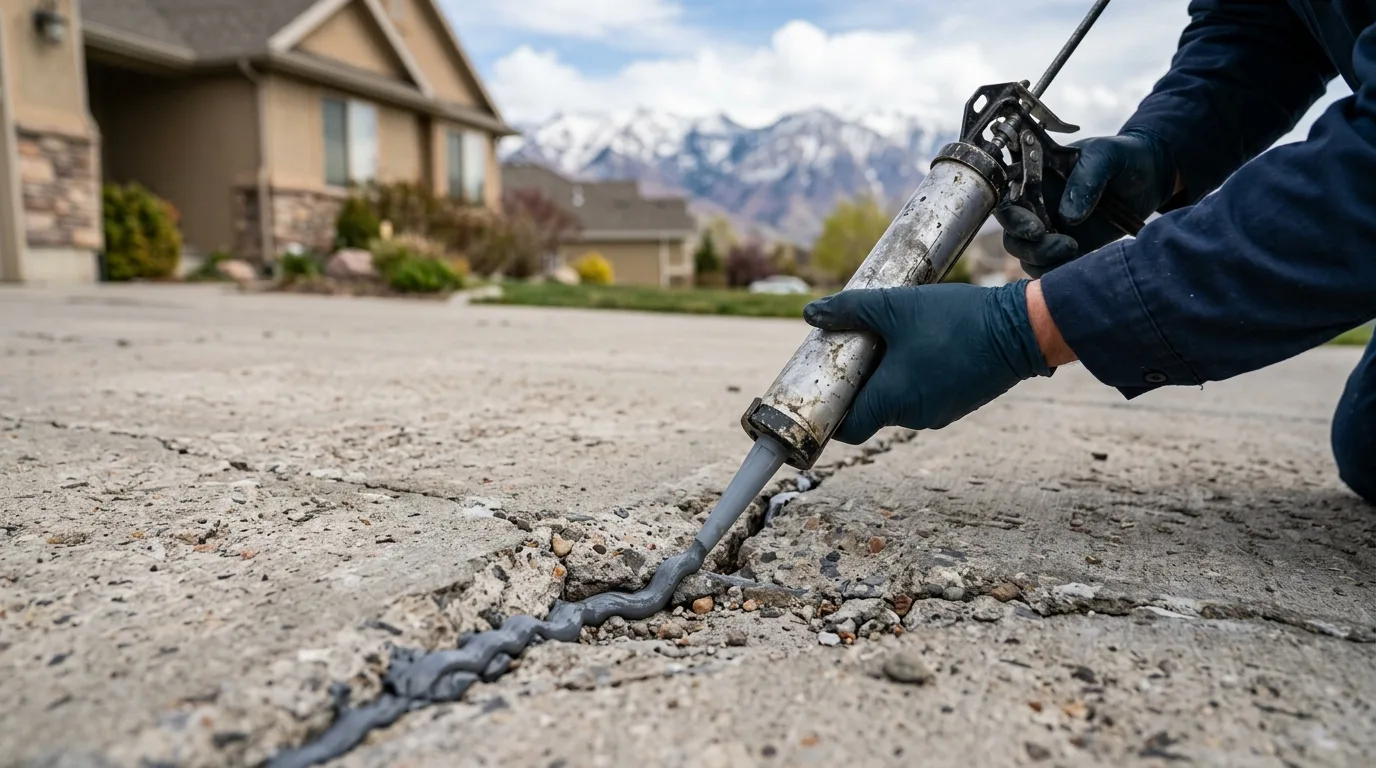
Most Sandy homeowners who need new concrete have been patching the same surface for years — filling cracks in spring, watching new ones appear by fall. At some point, the math changes: repair costs approach replacement cost, the repaired surface still looks bad, and you’re funding a losing battle against Sandy’s freeze-thaw cycles. This guide identifies the 7 clearest signs that your driveway, patio, or sidewalk has passed the repair threshold and needs new concrete — specific indicators that tell you when it’s time to stop patching and start fresh.
Is It Time for New Concrete in Sandy?
Sandy Concrete Pros provides free replacement assessments — honest recommendations, no pressure. Call (888) 376-0955.
Why the Repair-vs-Replace Line Matters in Sandy
Sandy’s freeze-thaw cycle frequency means that concrete in poor condition degrades faster than it would in milder markets. A surface with 40% spalling that might limp along for 5 more years in a mild climate may last only 2–3 winters in Sandy before structural deterioration makes it a safety hazard. This acceleration makes it more important to accurately identify the repair-vs-replace threshold in Salt Lake County than in most other markets — and to act on it before the situation becomes urgent or dangerous.
The cost difference between a timely replacement and an emergency replacement after a slab failure is significant. Planned replacement in Sandy’s optimal spring season (April–June) allows proper timing, competitive bidding, and optimal curing conditions. Emergency replacement after a slab fails can mean higher costs, rushed scheduling, and reduced ability to do proper base preparation. Knowing the 7 signs helps you plan ahead rather than react in a crisis.
The 7 Signs Your Sandy Concrete Needs Replacement
Sign 1: Cracks Covering More Than 30% of the Surface
Isolated cracks are repairable. When cracking is distributed across most of a driveway or patio surface in Sandy, the slab has undergone systemic structural failure — typically the combined result of inadequate base preparation, insufficient air entrainment in the original concrete, and years of freeze-thaw stress in Salt Lake County’s winters. At 30%+ crack coverage, resurfacing overlays can’t effectively bridge the distributed movement, and crack-fill repairs become a maintenance treadmill. The Willow Creek and Pepperwood neighborhoods have many driveways that reached this threshold after 20+ years without proper sealing.
Sign 2: Surface Spalling Across Multiple Areas
Spalling — the concrete surface layer breaking away to expose aggregate — indicates that the cement paste matrix has failed beyond repair in those zones. Spot-repair of isolated spalling is economical. When spalling appears in multiple disconnected areas across a driveway or patio, the failure is systemic, meaning the entire surface layer has degraded below a structural threshold. Resurfacing can restore appearance but cannot restore the lost concrete depth, and further freeze-thaw cycles will continue attacking the compromised surface.
Sign 3: Settlement More Than 1 Inch Between Adjacent Panels
Minor settlement of up to 1/2 inch can be addressed with mudjacking in many Sandy soil conditions. When adjacent slab sections differ by 1 inch or more in elevation, the sub-base has failed structurally — either through void formation from water erosion or from expansive clay shrinkage in Sandy’s lower-elevation areas. At this level of differential, mudjacking may lift the slab but doesn’t rebuild the compromised base. New concrete with correct base preparation at 6–8 inches depth is the proper long-term solution.
Sign 4: Heaving That Recurs After Leveling
If your Sandy driveway or walkway has heaved, been ground down or lifted, and heaved again the following winter, the underlying cause is active — either frost heave from inadequate drainage or expansive soil that continues to swell and shrink with moisture changes. Grinding creates a temporary level surface without fixing the mechanism that caused the heave. Recurring heave is the clearest sign that the surface must be replaced with corrected drainage and sub-base preparation.
Sign 5: Concrete Over 30 Years Old With Visible Deterioration
Concrete installed in Sandy before air-entrained concrete became standard practice has already survived on borrowed time. At 30+ years, the concrete itself has accumulated enough freeze-thaw stress cycles to have significantly reduced structural capacity regardless of surface appearance. If that older concrete is also showing surface deterioration, the economics of repair deteriorate rapidly — you’re investing repair dollars in a substrate that has limited remaining lifespan. Replacement with properly specified modern concrete is the better 30-year investment.
Sign 6: Repair Estimates Exceeding 50% of Replacement Cost
When a contractor assesses your Sandy concrete and quotes repairs approaching half the cost of replacement, the math of total cost of ownership shifts toward replacement. A repair at 50% of replacement cost that extends service life by 5–8 years in Sandy’s climate costs more per year of service than a full replacement that provides 30–40 more years. This threshold is lower in Sandy than in mild climates because freeze-thaw cycle frequency shortens the effective lifespan of surface repairs.
Sign 7: Water Draining Toward Your Home’s Foundation
Regardless of concrete surface condition, concrete that drains water toward your home’s foundation rather than away from it represents a structural risk to the building — not just the slab. If your driveway, patio, or walkway has settled or shifted so that water now flows toward the foundation, replacement with proper drainage grading corrected into the new installation is a structural necessity, not just an aesthetic choice. This sign overrides any repair threshold analysis.
Practical Next Steps After Identifying These Signs
- 1–2 signs present: Assessment needed. Schedule a free evaluation from Sandy Concrete Pros to determine whether the slab’s structural integrity justifies repair or whether the full concrete replacement threshold has been reached.
- 3+ signs present: Plan for replacement. Get 2–3 written estimates from Sandy contractors for replacement with proper specifications — air-entrained concrete, correct base depth, rebar reinforcement, and drainage grading.
- Any safety hazard (trip height over 1/2 inch, heaving recurring): Address immediately. Sandy City can cite property owners for hazardous sidewalks that injure pedestrians.
Sandy Concrete Assessment — Know Whether to Repair or Replace
Free on-site evaluations from Sandy Concrete Pros throughout Salt Lake County. Call (888) 376-0955.
Cost of New Concrete in Sandy When These Signs Are Present
When replacement is the right call in Sandy, proper installation costs $5–$8 per square foot for plain gray concrete, starting at $6,000 for a standard residential driveway. Decorative or stamped concrete replacement runs $12–$20 per square foot. These prices include demolition, base preparation to correct depth, air-entrained concrete, rebar reinforcement, expansion joints, and initial sealing. Properties with drainage issues add $500–$2,000 for grading corrections — a necessary cost to prevent the same failure from recurring.
Frequently Asked Questions
How long does concrete last in Sandy, Utah?
Properly installed concrete with air-entrained mixes, adequate base depth, regular sealing, and no de-icing salt exposure lasts 30–50 years in Sandy. Concrete installed without these specifications — common in older Sandy driveways pre-2000 — typically lasts 15–20 years before reaching the replacement threshold. Regular maintenance sealing every 2–3 years is the highest-ROI maintenance action for extending concrete service life in Salt Lake County’s freeze-thaw climate.
What is the typical cost to replace a concrete driveway in Sandy?
Concrete driveway replacement in Sandy starts at approximately $6,000 for a standard residential installation with plain gray concrete at $5–$8 per square foot. Total project cost including demolition, base preparation, permits, and initial sealing runs $5,000–$12,000 for a typical two-car driveway of 600–800 sq ft. Decorative or stamped concrete driveway replacement costs $7,200–$16,000 for the same footprint. Contact Sandy Concrete Pros for a free written estimate specific to your driveway dimensions and finish preferences.
Can I extend my concrete’s life instead of replacing it?
For concrete showing fewer than 3 of the 7 replacement signs, targeted repair and sealing can extend service life by 5–15 years in Sandy’s climate. This requires addressing the root cause of any damage, using appropriate repair materials rated for freeze-thaw conditions, and committing to the 2–3 year sealing maintenance schedule. Concrete showing 3+ signs of the 7 listed above has generally passed the economical repair threshold — continued repair spending doesn’t recover the concrete’s structural capacity.
New Concrete for Your Sandy Home — Free Estimate
Sandy Concrete Pros provides free, no-obligation replacement estimates with full specifications. Call (888) 376-0955 to schedule.
Related: