
Best Time to Pour Concrete in Sandy, Utah: Seasonal Guide
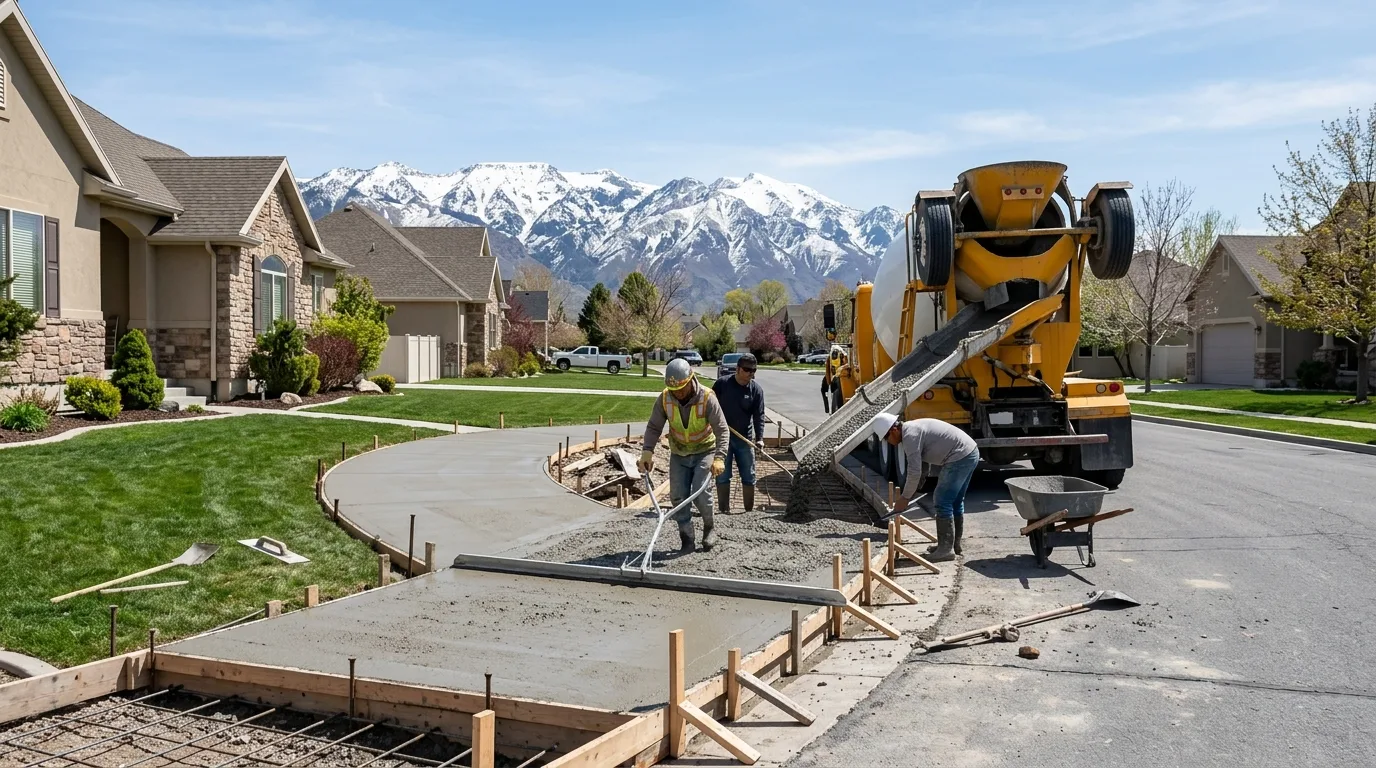
Sandy homeowners asking about concrete driveway or patio timing are really asking a safety question: will the concrete cure properly, or will temperature extremes ruin it before it hardens? Unlike many home improvement projects, concrete has a narrow temperature window for proper curing — and Salt Lake County’s climate presents that window clearly in spring and fall while closing it hard in both winter and peak summer. In this guide, we walk through each season’s concrete risks and opportunities in Sandy so you can schedule your project for success.
Schedule Your Sandy Concrete Project at the Right Time
Sandy Concrete Pros advises on optimal timing for every project in Salt Lake County. Call (888) 376-0955.
Why Timing Matters for Concrete in Sandy’s Climate
Concrete curing is a chemical process, not a drying process — the cement reacts with water (hydration) to form the crystalline matrix that gives concrete its strength. This hydration reaction is temperature-sensitive: too cold, and it slows to a stop or produces weak ice crystals instead of strong cement crystals; too hot and dry, and surface moisture evaporates before hydration can complete, creating surface defects and weaker concrete throughout. In Sandy, Utah, with its -17°F winter lows and 111°F summer highs, these extremes are not hypothetical — they happen regularly.
Most concrete specifications require surface temperatures to stay above 50°F for the first 7 days of curing. In Sandy, that window is reliably available in late spring and early fall. Summer brings the opposite challenge: surface evaporation rates in Sandy’s semi-arid air exceed safe levels on warm afternoons, requiring early-morning pours, evaporation retardants, and wet curing methods to achieve full strength.
Types of Seasonal Risk in Sandy’s Concrete Calendar
December–February (High Risk — Cold): Average lows drop well below freezing. Concrete poured when sub-grade or ambient temperatures are below 32°F freezes before hydration can develop adequate strength — producing weak, frost-damaged concrete that cannot be recovered. Winter pours require heated enclosures, insulated concrete blankets, and accelerating admixtures that add significant cost. Most Sandy contractors avoid winter pours; those that don’t charge premium rates. Concrete damage from winter freeze is irreversible — the slab must be removed.
March (Moderate Risk — Late Cold): Sandy’s temperature swings in March are unpredictable. Daytime highs above 50°F are common, but night temperatures routinely drop below freezing. Concrete poured on a warm March day can freeze overnight if blankets aren’t used. March pours are possible but require temperature monitoring and insulated blanket coverage for the first 7 nights. Early March is riskier than late March.
April 15 – June 15 (Optimal — Prime Season): Sandy’s best concrete window. Temperatures consistently above 50°F overnight, daytime highs in the 60–75°F range, and low to moderate evaporation rates. The concrete can be poured, finished, and cured with minimal risk of temperature-related defects. This is Sandy’s busiest concrete season — book 4–6 weeks in advance.
July–August (High Risk — Heat): Sandy’s dry summer heat creates rapid surface evaporation that causes plastic shrinkage cracking before the finisher can prevent it. Pours in July and August require early-morning starts (5–6 AM), evaporation retardant applied to the fresh concrete surface, windbreaks if there’s any breeze, and extended wet curing. Summer pours are possible but require an experienced crew and add cost. The risk of surface defects is significantly higher than spring or fall pours.
September 1 – November 1 (Optimal — Second Prime Season): Sandy’s second optimal concrete window. Temperatures fall back to the 55–75°F range, humidity increases slightly, and evaporation rates are manageable. Fall concrete often cures beautifully because the moderate temperatures and longer nights reduce moisture loss. Schedule fall projects before October 15 to ensure overnight temperatures stay above 40°F through the 7-day critical curing period.
Practical Scheduling Tips for Sandy Homeowners
- Spring driveways: Book in February or March for April–May installation. Spring fills fastest — Alta Canyon and Pepperwood neighborhoods see heavy concrete demand as homeowners assess winter damage after snowpack clears.
- Stamped patios: Optimal in May or September — neither extreme heat nor cold risk, and color development is most consistent at moderate temperatures.
- Sidewalk replacement: Early May after winter damage is visible. Coincides with Sandy City’s 50/50 program construction season and maximizes cure time before the next winter freeze-thaw cycle.
- RV pads: Late April through May to ensure full 28-day cure before summer parking season. Planning the pad in winter for spring installation is the standard approach.
- Commercial concrete: Large commercial pours are more sensitive to temperature variability — schedule in May or September for the most reliable cure results and minimal business disruption.
- Emergency repairs: Crack fills and small patches can be done nearly year-round in Sandy with appropriate product selection and temperature management. Contact Sandy Concrete Pros to discuss your specific repair timing.
How Sandy’s Seasonal Pattern Compares to Nearby Cities
Sandy’s elevation of 4,449 feet produces a concrete timing pattern different from Salt Lake City proper (4,226 feet) and significantly different from Provo to the south. Even small elevation differences affect overnight low temperatures — Sandy runs about 2–4°F colder than downtown Salt Lake City in spring and fall. Draper to Sandy’s south has similar conditions. Cottonwood Heights to Sandy’s east sits higher and has a narrower spring concrete window. West Jordan and Midvale have similar spring timing to Sandy, while Murray is slightly more forgiving due to lower elevation and more urban heat retention.
Sandy Concrete Scheduling Made Simple
We'll tell you the optimal window for your specific project in Sandy. Free estimates year-round — call Sandy Concrete Pros at (888) 376-0955.
Cost Factors Related to Timing
Concrete poured outside Sandy’s optimal windows costs more for three reasons: weather protection (blankets, heated enclosures, evaporation retardants), additional labor for monitoring and management, and higher risk of quality issues that require remediation. Summer pours in Sandy can add $0.50–$1.50 per square foot for evaporation management and early-morning labor premiums. Winter pours with full heat protection can add $2–$5 per square foot. Spring and fall pours need no weather-related supplements — the season naturally provides optimal curing conditions.
Frequently Asked Questions
What month is best to pour concrete in Sandy, Utah?
May is generally the single best month for concrete in Sandy — temperatures are consistently above 50°F at night, daytime highs are moderate (65–78°F), and Sandy’s spring freeze risk has typically passed after May 1. The second-best window is September through mid-October. Both windows provide the temperature stability concrete needs for full hydration without temperature-related defects.
Can you pour concrete in Sandy in November?
Early November is marginal in Sandy. Average nighttime lows in November drop below 32°F regularly, and concrete poured after October 15 is at meaningful freeze risk during the critical first 7 days of curing. If your project requires November work, we use insulated concrete blankets for the first 7–10 nights and select an accelerating admixture to reduce cure time. The cost premium is moderate but the risk is manageable with proper precautions. December through February pours in Sandy are generally avoided.
Does summer heat affect concrete quality in Sandy?
Yes — Sandy’s semi-arid summer air and afternoon heat (85–100°F in July and August) cause rapid surface moisture evaporation that competes with the hydration process. Plastic shrinkage cracks form at the surface before the concrete has developed enough tensile strength to resist them. We address this with early-morning pours (concrete placed before 8 AM), evaporation retardant spray applied during finishing, and curing compound or wet burlap applied immediately after finishing. Summer pours require more skilled crews and add cost.
Book Your Sandy Concrete Project for the Right Season
Spring slots fill fast in Sandy — call now to schedule. Sandy Concrete Pros: (888) 376-0955.
Related: