
Sandy Utah Expansive Soil & Concrete: Homeowner's Guide
Many Sandy homeowners assume their cracking concrete slab is a problem with the concrete — but the cause is often what’s underneath it. Sandy sits on a complex mix of alluvial soils from the Wasatch Front and ancient Lake Bonneville clay deposits, and certain areas of the city contain expansive soils that shrink and swell with moisture content changes. This movement lifts and drops concrete slabs repeatedly over years, causing cracking, settling, and joint failure that no surface repair can permanently solve without addressing the ground beneath. In this post, we cover where Sandy’s problematic soils are concentrated, how to identify soil-related concrete damage, what proper base preparation looks like, and what your repair options are if your slab is already affected.
Concrete Settling in Sandy? Get a Foundation Assessment
Sandy Concrete Pros evaluates sub-base conditions and provides honest repair recommendations. Call (888) 376-0955.
Why Sandy’s Soil Affects Concrete Flatwork
Sandy occupies the alluvial terrace of the Wasatch Front at 4,449 feet elevation. The majority of the city’s soils are well-drained Wasatch series alluvium — deep, excessively drained soils derived from metamorphic and igneous rock transported by the Jordan River and Cottonwood Creek. These soils are generally excellent for concrete because they drain well and don’t shrink or swell significantly. In the Alta Canyon and Pepperwood foothill areas, these alluvial soils are the dominant type and concrete performance is generally good when properly installed.
The problem lies in Sandy’s lower-elevation areas, particularly near the Jordan River and in areas that were historically part of ancient Lake Bonneville — the Pleistocene lake that once covered much of the Great Basin. Lake Bonneville’s bed left clay-rich lacustrine sediments that are now buried beneath younger alluvial deposits throughout parts of Midvale, Sandy’s lower-elevation western areas, and the I-15 corridor. These clay deposits are highly expansive — they absorb moisture during Sandy’s wet springs and snowmelt season, expanding by 10–20% of their volume, then shrink during dry summers. A concrete slab above expansive clay moves up and down with this cycle every year.
Types of Soil-Related Concrete Damage
Differential Settlement: Different sections of a slab settle at different rates because the soil beneath them compresses unevenly. Common in Willow Creek and older Sandy neighborhoods where original construction didn’t account for soil variability across the lot. Results in a slab that’s level at one edge and several inches lower at another.
Heaving: The opposite of settlement — sections of the slab are pushed upward by frost heave or soil expansion during wet periods. Trip hazards and door clearance issues are the most common symptoms in Sandy driveways and sidewalks.
Peripheral Cracking: Cracks that follow the perimeter of a slab section where soil movement creates a cantilever stress. The middle of the slab is supported by settled soil while the edges have lost support — or vice versa — and the slab cracks along the stress line.
Longitudinal Cracking: Cracks running the length of a driveway or patio, often following the direction of the underlying clay layer’s expansion axis. These look like traditional shrinkage cracks but are wider (1/2 inch or more) and continue to grow each season.
Practical Steps for Sandy Homeowners with Expansive Soil
- Identify your soil zone: Sandy City and Salt Lake County soil survey data can identify whether your property sits on alluvial or lacustrine soils. Properties west of approximately 300 East and in lower-elevation areas near the Jordan River corridor are most likely to have significant expansive clay content.
- Control moisture around slabs: Consistent soil moisture reduces the swell-shrink cycle’s amplitude. Irrigation timers set for consistent watering near concrete edges help; inconsistent watering or drought-flooding cycles accelerate slab movement.
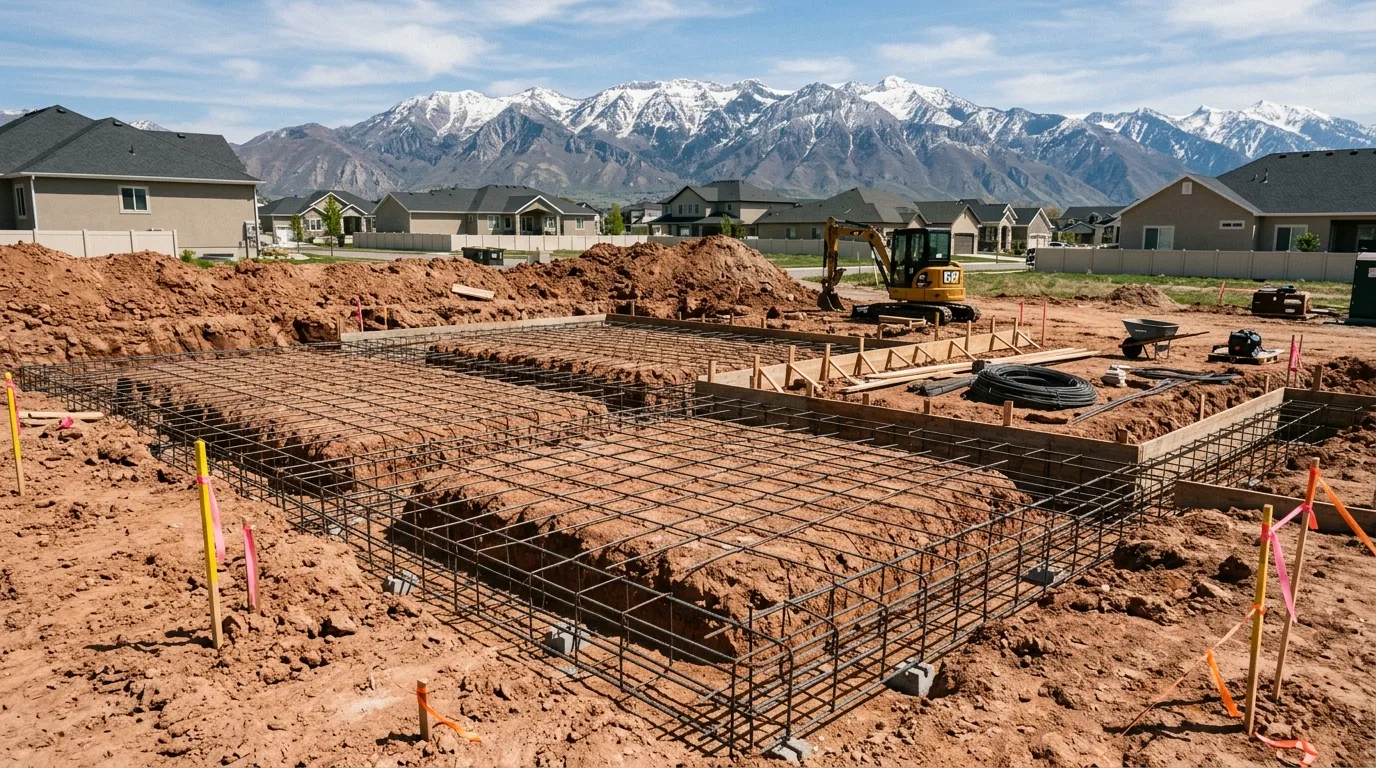
- Install proper sub-base depth: New concrete slabs over potentially expansive soil should have 6–8 inches of compacted gravel base — deeper than the standard 4 inches used on stable soil — to buffer the movement between soil and slab.
- Use rebar reinforcement, not wire mesh: Expansive clay creates lateral as well as vertical movement that wire mesh cannot resist adequately. Rebar in a 24-inch grid pattern provides the tensile strength a slab needs to resist soil-induced bending forces.
- Repair cracks promptly: An open crack allows water infiltration that feeds the soil-moisture cycle. Polyurethane crack fill creates a flexible seal that moves with the slab without re-opening in Sandy’s temperature range.
How Expansive Soil Affects Concrete Repair Planning
The most important aspect of repairing concrete on expansive soil in Sandy is sequence: address the drainage and sub-base issue before repairing the surface. Homeowners in Dimple Dell Heights who resurface a settling concrete patio without correcting the soil-moisture cycle beneath it will see the new overlay crack within 1–2 seasons. Sandy Concrete Pros evaluates sub-base conditions during every concrete repair estimate and advises on whether a drainage correction, sub-base replacement, or slab leveling is needed before surface work proceeds.
For slabs that have settled but are otherwise structurally sound, mudjacking — pumping a slurry of concrete, soil, and water beneath the slab through small drilled holes — lifts the slab back to level without replacement. This approach works well on Sandy’s lower-elevation areas where void formation beneath slabs is the primary issue. For slabs on active expansive clay, full removal, proper base installation, and replacement with reinforced concrete is often the better long-term investment.
Settling Concrete in Sandy? Let Us Assess the Sub-Base
Free on-site evaluations for Sandy concrete settling and cracking — we diagnose the cause before recommending a solution. Call (888) 376-0955.
Cost Factors for Concrete Work on Expansive Soil
Concrete work over expansive soil in Sandy costs more than standard installations because proper base preparation requires deeper excavation, more compacted base material, and heavier reinforcement. A standard residential driveway on stable soil requires 4 inches of road base; on potentially expansive soil, 6–8 inches of base plus geotextile fabric below the base adds $1–$3 per square foot to the base preparation cost.
Rebar reinforcement over wire mesh adds another $0.50–$1.50 per square foot. These additions on a typical Sandy driveway of 600 sq ft add $900–$2,700 to the project cost — but they’re the difference between a driveway that lasts 30+ years and one that requires repair within 5 on problematic soil. Sub-base corrections on existing slabs — drainage grading, sub-base excavation and replacement — add $1,000–$5,000 depending on the extent of the correction required.
Frequently Asked Questions
How do I know if my Sandy property has expansive soil?
Sandy’s foothill areas (Alta Canyon, Cottonwood Heights boundary) sit on well-drained alluvium — expansive soil is less common there. Lower-elevation areas near the Jordan River and the western portions of Sandy near the I-15 corridor are more likely to have clay-bearing lacustrine deposits. The most reliable indicator is concrete behavior: if your driveway or patio moves up and down seasonally or cracks appear in patterns that suggest movement rather than shrinkage, expansive soil is likely. A simple swell test on soil samples from your sub-base can confirm — contact Sandy Concrete Pros for an on-site evaluation.
Can I repair concrete settling on expansive soil without replacing it?
Yes, in many cases — mudjacking lifts settled slabs back to level without replacement, and polyurethane foam injection is a lightweight alternative for smaller sections. These approaches work when the slab itself is structurally intact but has lost sub-base support. If the slab has cracked into multiple pieces due to soil movement, replacement with proper base preparation is more cost-effective. See our concrete repair guide for Sandy for a repair-vs-replace decision framework.
Does expansive soil void my concrete warranty?
Expansive soil conditions are typically disclosed during a professional estimate, and proper base preparation specifications account for them. If a contractor installs standard base depth on expansive soil without disclosure or specification upgrade, that’s an installation deficiency. A written contract that specifies sub-base depth, reinforcement type, and drainage corrections provides the documentation needed to hold contractors accountable for appropriate installation standards.
Sandy Concrete Pros — Soil-Aware Installation & Repair
We evaluate soil conditions before recommending solutions. Free assessments for Sandy, Salt Lake County homeowners. Call (888) 376-0955.
Related: