
Concrete RV Pads in Sandy Utah: What Homeowners Need to Know
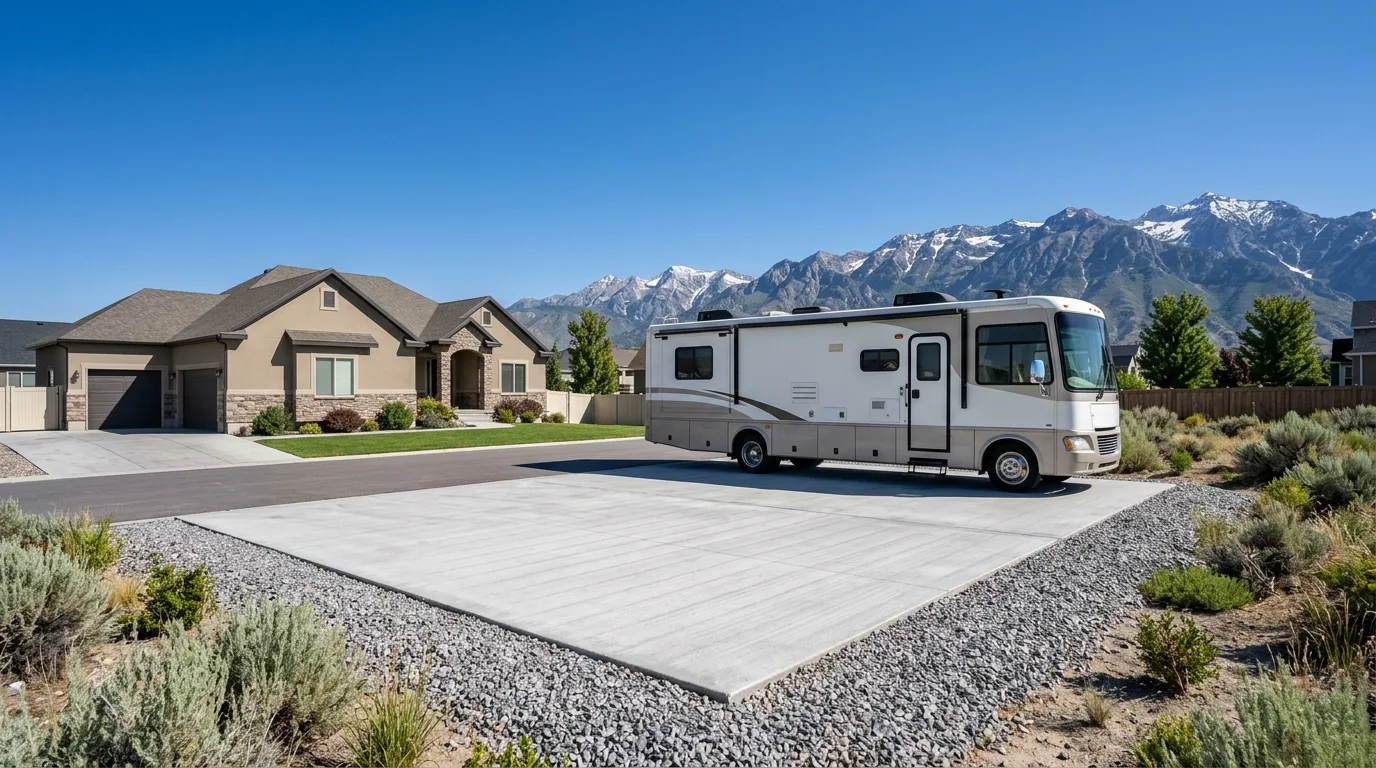
Sandy, Utah homeowners with RVs, fifth-wheels, or boat trailers regularly park them on gravel or grass that deteriorates into mud and rutted tracks within a few seasons. Concrete is the obvious long-term solution — but not just any concrete. A concrete RV pad that supports a 15,000–30,000-pound vehicle through Salt Lake County’s freeze-thaw winters requires different specifications than a residential driveway or patio slab. This guide covers what makes RV pad concrete different, sizing considerations for different vehicle types, what Sandy City permits are required, and what your total investment looks like for a properly built RV pad in Sandy.
Concrete RV Pad Estimates in Sandy
Sandy Concrete Pros sizes and reinforces RV pads for your specific vehicle. Free estimates throughout Salt Lake County. Call (888) 376-0955.
Why RV Pad Concrete Is Different From Regular Concrete
The defining characteristic of an RV pad load is point concentration. A standard passenger car distributes its 3,000–4,000 pound weight across four tires with relatively broad contact patches. A Class A motorhome or fifth-wheel trailer distributes 15,000–30,000 pounds across four narrow tire contact points that may sit directly over the same spot for weeks or months during storage season. This concentrated static load on Sandy’s alluvial soils — which drain well but can be variably compacted across the Wasatch Front terrace — requires concrete that’s substantially thicker and more reinforced than standard residential concrete.
Sandy homeowners in Riverton and family-oriented neighborhoods with large lots see this failure pattern most often: a contractor installs a “driveway extension” using standard 4-inch residential concrete, and within 3–5 seasons of RV storage through Sandy’s freeze-thaw winters, the slab shows cracking beneath the tire contact points where the concentrated load and frost heave combine to exceed the unreinforced concrete’s capacity. Proper RV pad specifications eliminate this failure mode.
Types of Concrete RV Pad Configurations in Sandy
Standard RV Pad (12 x 40 feet, 5-inch concrete, #4 rebar on 18-inch grid): The baseline specification for most RVs and fifth-wheel trailers under 20,000 lbs in Sandy. This configuration handles the vehicle load across Sandy’s alluvial soils with standard Wasatch series drainage. Total area: 480 sq ft. Estimated cost in Sandy: $2,880–$5,760.
Heavy Duty Pad (12 x 45 feet, 6-inch concrete, #5 rebar on 18-inch grid): Required for Class A diesel push motorhomes, larger fifth-wheels over 20,000 lbs, and any vehicle with slide-out extensions that add significant loaded weight. Provides greater point-load resistance and improved freeze-thaw durability through Sandy’s winters. Total area: 540 sq ft. Estimated cost in Sandy: $3,780–$7,560.
Tandem Pad (12 x 60+ feet): For properties in Sandy’s Dimple Dell Heights or Crescent neighborhoods with large lots that want to park both an RV and a boat trailer on a single continuous slab. Requires coordination with HOA restrictions (many Sandy HOAs limit visible RV storage to side-yard locations). Total cost scales with square footage.
Combined Driveway/RV Extension: Where the driveway itself is extended with a reinforced section for RV storage adjacent to the main vehicle lane. Most efficient use of contractor mobilization, though the reinforcement specifications for the RV section must be clearly separated from the standard driveway section in the estimate.
Practical Considerations for Sandy RV Pad Projects
- HOA restrictions: Many Sandy neighborhoods have HOA rules limiting RV storage visibility from the street. Side-yard and rear-yard pad locations often comply where front-yard installations don’t. Review your HOA CC&Rs before committing to a pad location.
- Sandy City setback requirements: Building permits for concrete slabs require compliance with setback distances from property lines, structures, and drainage easements. Sandy Building & Safety at (801) 568-7251 can advise on setbacks for your specific property.
- Utility locating: ALWAYS call 811 before any concrete excavation in Sandy. RV pads require 8–12 inches of excavation — sufficient to strike buried utilities without proper locating.
- Drainage connection: The pad surface must slope away from any structure and drain to a designated area. Sandy’s foothill lots often have natural drainage channels — the pad should connect to, not interrupt, these drainage patterns.
- Access width: The approach from street to pad must accommodate your vehicle’s turning radius. Class A motorhomes need wide, gradual approaches — factor this into the driveway apron design if modifying an existing driveway to add RV storage.
- Electrical service: Many Sandy RV pad projects add a 30-amp or 50-amp electrical outlet for RV connection during storage — plan conduit installation during the concrete pour to avoid breaking the slab later.
How Sandy’s Climate Affects RV Pad Durability
Sandy’s freeze-thaw cycle frequency creates a specific stress pattern for RV pads. The combination of vehicle load concentrated on tire contact points and overnight freeze-thaw expansion creates a cyclical stress that challenges both the concrete surface and the sub-base beneath it. Water that infiltrates the pad’s surface or perimeter during snowmelt and freezes overnight exerts lateral pressure against the slab edges — a common cause of RV pad edge crumbling in Sandy neighborhoods where the edge wasn’t thickened to 6 inches.
Air-entrained concrete is non-negotiable for RV pads in Salt Lake County. The microscopic air bubbles created by air-entraining admixtures give expanding ice somewhere to go within the concrete matrix, reducing surface fracture pressure dramatically. Combined with penetrating sealer applied at project completion and reapplied every 2–3 years, an air-entrained RV pad in Sandy handles the combined freeze-thaw and vehicle load stress of Wasatch Front winters without surface degradation.
Heavy-Duty RV Pads in Sandy — Free Estimates
Sandy Concrete Pros builds RV pads to vehicle-specific specifications. We handle permits, drainage, and construction. Call (888) 376-0955.
Cost Factors for Concrete RV Pads in Sandy
Concrete RV pads in Sandy typically cost $6–$12 per square foot for properly reinforced installations. The main cost variables are pad dimensions, concrete thickness (5 vs. 6 inch), rebar size and grid spacing, excavation depth and base preparation, drainage grading requirements, and Sandy City permit fees. Sites with complex drainage or significant slope add $500–$2,000 for grading work. Electrical conduit installation during the pour adds $200–$500 and prevents a much more expensive cut-and-patch later.
A complete 12x40-foot RV pad project in Sandy typically runs $3,500–$7,000 including excavation, base prep, 5-inch concrete with rebar, drainage grading, initial sealing, and permit fees. Larger or heavier-duty installations scale proportionally. We provide detailed written estimates with all cost factors itemized before any commitment.
Frequently Asked Questions
What size concrete pad do I need for my RV in Sandy?
Standard motorhomes and fifth-wheels need a minimum 12-foot-wide pad to allow clearance on both sides. Length depends on your specific vehicle — measure from front bumper to rear of hitch or slide-out at maximum extension, then add 2–3 feet for positioning tolerance. Most Sandy RV pads are 12x40 feet to 12x50 feet. Class A diesels need 12x45 feet minimum. Boat trailers typically need 10x24 feet to 12x30 feet. We recommend measuring your vehicle and adding clearance rather than estimating from vehicle class.
Do I need a permit for a concrete RV pad in Sandy?
Sandy City requires a building permit for most concrete RV pads under the General Concrete S260 category. HOA approval is also required in most Sandy neighborhoods before any concrete work that adds impervious surface. Contact Sandy Building & Safety at (801) 568-7251 for permit requirements specific to your property location and pad dimensions. Sandy Concrete Pros handles permit applications and HOA documentation as part of every RV pad project.
How long does concrete take to cure before parking an RV?
Concrete for RV pads requires the full 28-day cure period before heavy vehicle loads are applied. Light foot traffic is acceptable after 7 days. Parking any vehicle over 5,000 lbs on freshly poured concrete before 28 days risks permanent surface damage — the concrete hasn’t achieved its full design strength yet, and heavy concentrated point loads during early cure create permanent surface deformation that can’t be repaired without replacement. Schedule your pour to allow the full 28-day cure before your vehicle arrives for storage.
Ready to Park Your RV on a Proper Concrete Pad in Sandy?
Sandy Concrete Pros builds heavy-duty RV pads throughout Salt Lake County. Call (888) 376-0955 for your free estimate.
Related: